OpenAI proposes ban on Chinese AI platform DeepSeek amid national security concerns
OpenAI has taken a significant stance against DeepSeek, a Chinese artificial intelligence platform, by proposing a ban on its use within U.S. government, military, and intelligence services. The proposal, spotted by Techradar, extends beyond just the ban on DeepSeek, recommending restrictions on the use of Chinese-produced technology, including Huawei's chips, which OpenAI argues could compromise user privacy and national security due to risks like intellectual property theft.
OpenAI's Vice President of Global Affairs, Chris Lehane, has characterized DeepSeek as “state-subsidized” and “state-controlled,” emphasizing concerns about potential manipulation by the Chinese government. The tech giant is particularly concerned about the push by the Chinese Communist Party (CCP) to surpass the United States in artificial intelligence by 2030, urging the U.S. to maintain its leadership in AI built on democratic principles.
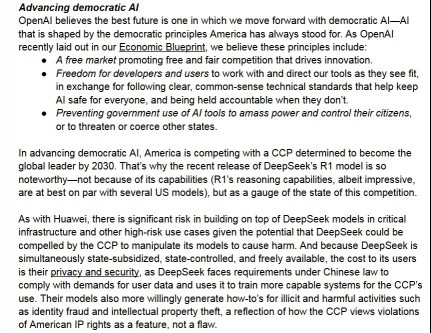
DeepSeek recently shook the AI industry by providing comparable output to OpenAI's ChatGPT through its DeepSeek-R1 model at a fraction of the cost, sparking an immediate drop in stock prices for companies heavily invested in AI, including NVIDIA. While the market has since bounced back, questions linger over how DeepSeek achieved such rapid advancements. Analysts are speculating about whether it employed innovative training methodologies or extracted data from OpenAI, potentially violating terms of service.
Moreover, there are concerns regarding the application of DeepSeek in critical infrastructure, given the possibility that it could be coerced by the CCP to alter its models maliciously. Although there is currently no direct evidence implicating the Chinese government in DeepSeek's operations, its chatbot has displayed limitations when engaged with politically sensitive topics.
OpenAI wants the AI Action Plan to ensure that American innovations in the field of Artificial General Intelligence (AGI), thrive against the backdrop of authoritarian technologies, seeking a future where individuals can access and benefit from AI freely.
RECOMMENDED NEWS

Firefox Nightly for Android lets you install add-ons from files
Last week, Mozilla added support for over 450 add-ons for Firefox for Android. Now, the experimenta...

Memory Cache: local AI for Firefox that you feed
Current integrations of AI in web browsers rely on remote connections to servers. This is where the...

YouTube is automatically skipping videos if you use Adblock Plus
Google's tug of war with ad blockers continues. This time, Adblock Plus users are reporting that vi...

AMD plans to make huge game downloads smaller in the future
Computer games seem to grow bigger with each passing year. Gone are the days that an entire game fi...

Update for Windows Update adds end-of-support actions
With last month's scheduled security update for Windows 10 and 11 came another update that Microsof...

OpenAI launches Sora, an AI tool that generates videos from text
OpenAI has announced a new AI model that can create videos from text. Say hello to Sora. Sora...
Comments on "OpenAI proposes ban on Chinese AI platform DeepSeek amid national security concerns" :