Brave Browser: strict fingerprinting protection will be removed
Brave Software announced that it will remove the strict fingerprinting option from its Brave Browser. The company cites several reasons for the removal, including that it has been a major website breakage cause in the past.
Fingerprinting refers to a tracking technique on the Internet that uses information to create unique fingerprints of users. The technology combines open data, such as the browser's user agent or operating system of the device, with data that can be retrieved through APIs.
Fingerprints are created and then compared whenever a user visits a resource.
In the past, technologies have emerged to fingerprint users using custom browser protocol handlers, graphics processing units, or language and font information.
Fingerprinting has gotten better over time, thanks to the introduction of new APIs and also technological advancements. In 2023, a proof of concept site claimed that it could track users with a 99.5% accuracy.
Browser makers like Brave Software or Mozilla have introduced anti-fingerprinting capabilities into their browsers long ago. These are designed to render fingerprinting attempts useless. Some protective features may block access to certain information while others may generate data that is useless for the purpose of tracking users.
Brave Browser: fingerprinting
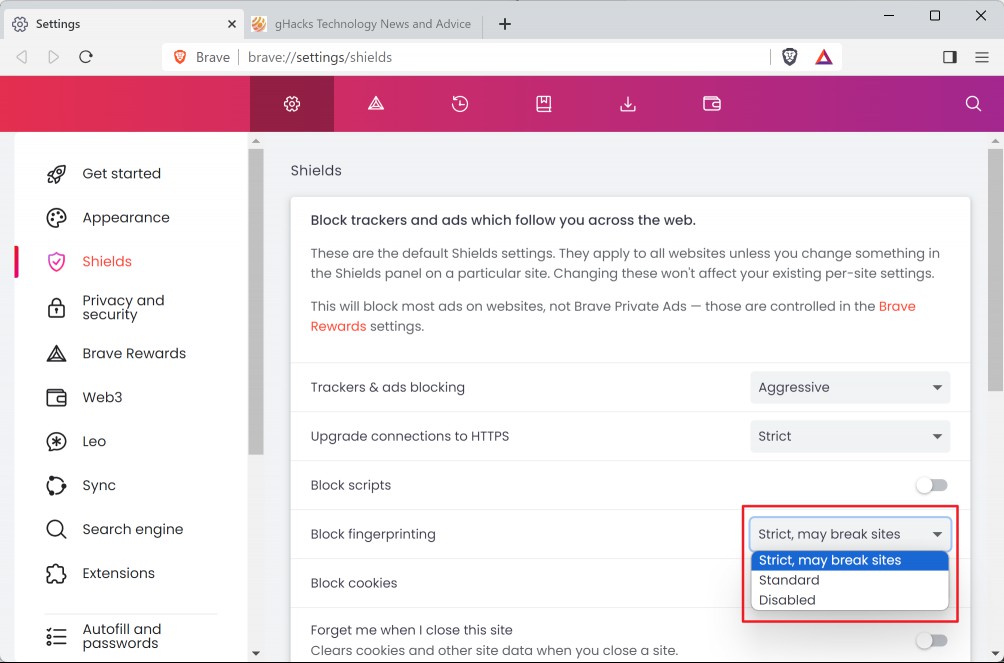
Brave Browser users may set fingerprinting to standard, strict or disabled at the moment. Strict applies additional protections.
Brave Software notes that it has identified several issues in the browser's strict fingerprinting blocking mode. Strict mode may cause some websites to function differently or not at all according to the company. The breakage forces Brave engineers to spend time addressing these issues instead of "focusing on default privacy protections".
The third argument is that the feature is used by fewer than 0.5% of all Brave users. Brave Software argues that the small number could make fingerprinting more likely.
The main argument against strict fingerprinting is that it binds engineering resources because of website compatibility issues.
The decision has been made to sunset strict fingerprinting protections in all Brave Browser versions in the near future. The latest Brave Canary releases already come without it.
Brave Software claims that its fingerprinting protections are "the strongest of any major browser" and that standard is still protecting users against fingerprinting attacks.
Brave users may load brave://settings/shields in the browser's address bar to check the "block fingerprinting" setting there.
Closing Words
The removal of strict fingerprinting protections in Brave affects a fraction of the browser's userbase. Strict is not the default setting and only the most privacy conscious users may have set fingerprinting protections to strict.
Google started to remove third-party cookies support in Chrome earlier this month and plans to drop support for all Chrome users later this year. Cookies are widely used for tracking purposes. The removal in the world's most used browser may fuel other tracking methods, including fingerprinting.
Now You: do you use fingerprinting protections in your browser?
RECOMMENDED NEWS

YouTube's server-side ads resulted in a black screen for ad blocker users
About a month ago, we reported that YouTube has begun testing server-side ads. Now, users are repor...

What you need to know about Microsoft Office 2024
Microsoft released a new non-subscription version of Microsoft Office for home users and businesses...

Windows 11 24H2: Cleanup is no longer deleting all temporary files
Running cleanup after a successful update to a new Windows version allowed you to free up gigabytes...

Claude AI's upcoming voice feature will transform the user experience
Anthropic's Claude AI is set to receive significant updates that could reshape user interactions wi...

Windows 11: How to add JPEG-XL support officially
Microsoft's Windows 11 operating system supports a wide range of file formats by default. JPEG XL, ...

Star Wars: Zero Company officially announced; turn-based tactics game set during the Clone Wars
Star Wars: Zero Company has been officially announced by Electronic Arts. The game is developed by ...
Comments on "Brave Browser: strict fingerprinting protection will be removed" :