Dell's Windows Copilot concept shows what Microsoft failed to deliver
When Microsoft released Windows Copilot to the masses, it promised that the new AI feature would help users control Windows 11. When users got their hands on Windows Copilot, they noticed quickly that the promised functionality was limited.
Even worse, all user requests required an active Internet connection and some patience, as it took a couple of seconds on average to get a response from the AI. We concluded in our initial review of the AI that there was not enough Windows in Windows Copilot to make it a useful tool. What remained was Bing Chat added as a sidebar to the Windows operating system and users disabled Windows Copilot as a consequence.
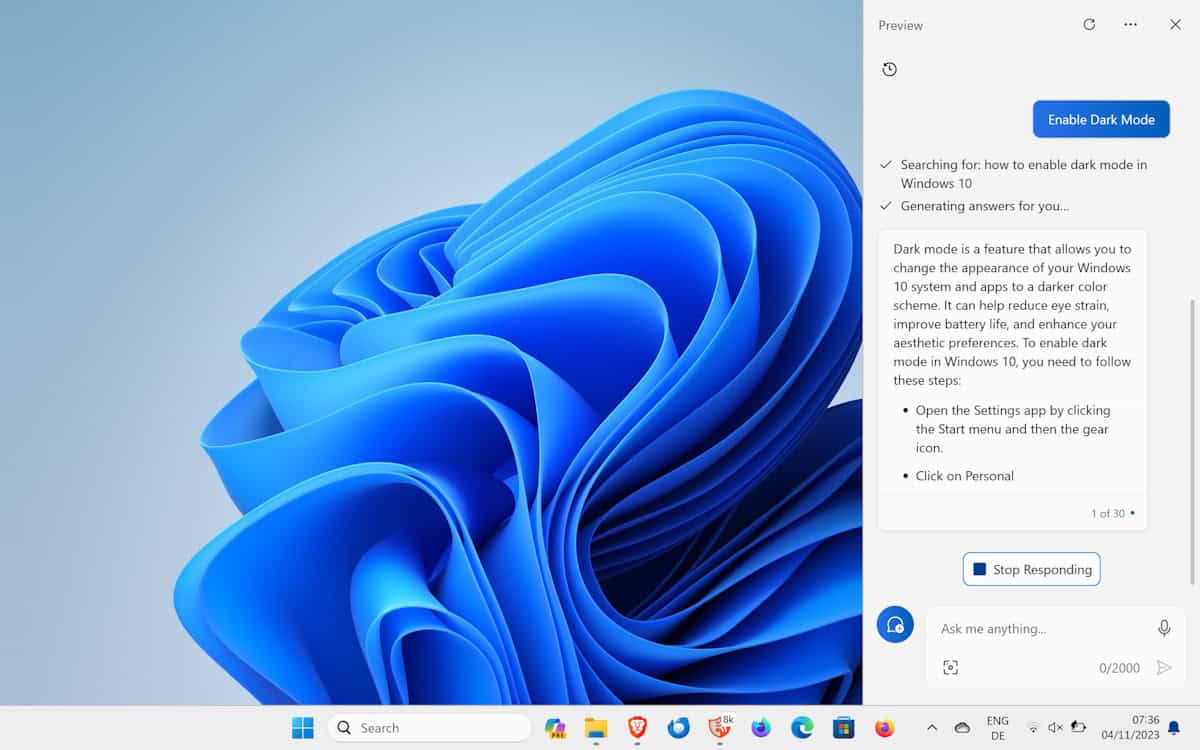
A second look at Windows Copilot confirmed the initial impression, unfortunately.
There is a chance that Windows Copilot will improve over time. Microsoft rushed it out apparently and work continues.
Dell showcased a demo of an advanced AI recently to Gizmodo. While just a concept, it shows what Windows Copilot could have been and maybe could become in the future. Dell's concept works similarly to Windows Copilot.
Users activate an icon on the taskbar to start interacting with the AI. Input supports text and voice, which is different from Windows Copilot already. What sets Dell's vision apart from Microsoft's current implementation is what comes next.
When users type or speak, the AI responds immediately. While it may not be feasible to run AI on user devices without Internet connectivity at this point in time, it visualizes how responsive the AI's responses can be.
Besides that, Dell's AI is more of a Windows helper that assists users when it comes to tasks. The user asks in one demo how they can change the brightness on their trackpad. Instead of getting text instructions on how to do that, which is what Windows Copilot would do, Dell's AI displays a brightness slider that users can interact with immediately.
But Dell's envisioned AI can also be proactive. In another demo, the AI informed the user that it detected a connection to a public Wi-Fi and made changes to the system automatically, such as setting security settings to high. The option to reverse these changes was displayed to the user.
It is just a concept
Dell's vision of an AI on Windows does not exist at this point. There is certainly a chance that Microsoft could improve Windows Copilot in some areas to expand its functionality on Windows. Whether Microsoft has the intention of doing so remains to be seen. Even if Microsoft plans to introduce additional Windows controls, there is still the responsiveness problem.
It could be overcome with a fixed set of actions and options that don't require an Internet connection. Depending on user input, Microsoft could add local processing to some of the commands and redirect to the remote server if the local AI can't make any sense of the input.
Maybe that will be possible when the first iteration of AI chips makes a debut and is supported by Windows. There is the rumor that the next version of Windows will put a focus on AI. It is doubtful that it will require an AI chip, as it would introduce another system requirements chasm, something that Microsoft likely does not want to risk.
Clearly, with Dell's vision going much further, there need to be controls. Users should be able to disable any automatic changes that the AI makes to the system.
Now You: do you use Windows Copilot? If not, what would it take for you to give it a try?
RECOMMENDED NEWS
ChatGPT no longer requires an account to use, but there are some limitations
OpenAI has announced a major change to its AI-based chat service. ChatGPT is now available for use ...
Windows 11: Pay attention to the Windows Photos App - it may be slowing down your PC
Many Windows users use the Microsoft Photos app to view images and videos. The main reason for that...
Microsoft confirms it will not lower Windows 11 system requirements
Microsoft has confirmed that the Windows 11 system requirements are not changing. Windows 10 users ...

Google Chrome: legit EditThisCookie extension removed instead of malicious copycat
EditThisCookie is a specialized extension for Google Chrome that you may use to edit cookie data st...
Outlook Mobile Enhances Multitasking with New Draft Management Feature
Microsoft has updated its Outlook app for Android and iOS, introducing a new feature that simplifie...

Windows has a new issue: printers may print on their own
Has your printer been acting strangely lately? By that, I mean printing pages even though you did n...
Comments on "Dell's Windows Copilot concept shows what Microsoft failed to deliver" :