Your Google Maps Location History will soon be stored on your devices
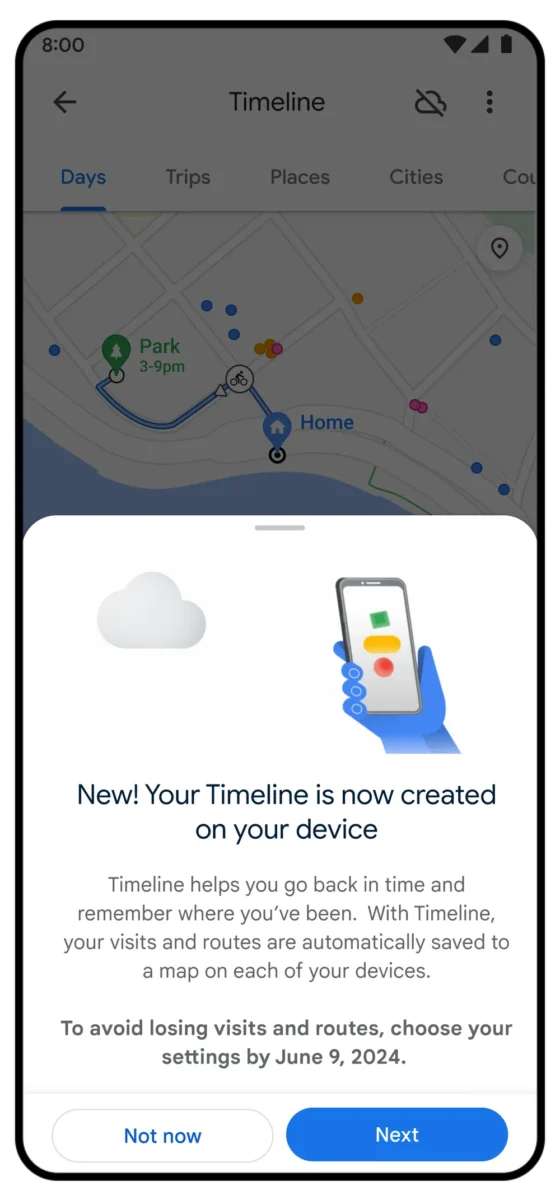
Google is making an important change to the Timeline feature of Google Maps. The feature is powered by the Location History setting and allows users to remember places they have been to in the past.
Up until now, information about these places was saved in the Google Cloud. Soon, the information is stored on the user's device on Android and iOS instead to improve privacy and give users more control over the feature.
Timeline allows users to revisit places they have been to in the past. This may help them rediscover places as well as routes and trips taken in Maps. Location History is a broader feature that helps users "get better results and recommendations" according to Google. You could use it to locate a missing phone among other things.
Location History submits quite some data to Google when enabled.
Google users may check out Timeline in any web browser by visiting this page. The page offers a timeline view of activities, provided that location history is on and that the user is signed in to a Google account.
Tip: you can check out my guide on disabling Google Location History here.
One positive effect of the change, at least in the United States, is that Google won't be able to provide law enforcement with this location data. So-called geofence warrants allow law enforcement in the United States to gain access to location data from companies like Google for specific area.
In other words. If you happen to be inside an area with a geofence warrant, your location data may be shared with law enforcement by Google.
Google Map's Timeline feature requires user activation. On Android, users find the setting under Settings > Personal Content > Location Settings. The page reveals if location and location history are on or off.
There are also options to delete a range of location history or configure automatic deletion rules.
Speaking of which, the default automatic deletion rule is 18 months currently. Location data is deleted after 18 months under this rule. Going forward, Google is going to change this default value to 3 months.
Users who require the longer retention may change it to 18 months or even turn off automatic deletions entirely.
Google Maps users who use the Timeline feature may back up the data to the Google Cloud to access it on all their devices. Backups are end-to-end encrypted to Google and the data won't affect storage quotas of the account.
Google will also introduce an option to delete the activity related to specific places and locations directly from Google Maps. The feature, which will roll out in the coming weeks, allows users to remove traces from Maps.
A new "delete" button next to visits removes the place from history. Useful if you want the place to disappear from your activity.
Access to location controls is being added directly to Google Maps as well. A tap on the blue dot on Google Maps, which highlights the current location, displays location history and timeline settings next to the usual options to get directions or pin the location. This option improves the visibility of the feature on Google Maps.
Google announced the change on its The Keyword blog and plans to roll it out over the course of 2024 to Android and iOS devices. Users will receive notifications when the feature becomes available.
Now You: do you use Google Maps and its Timeline feature? Which maps app do you favor?
RECOMMENDED NEWS

AdGuard Temp Mail: new temporary email service launched
AdGuard, best known for its content blocking solutions, has launched a temporary email service. Tem...

Microsoft Graveyard: last honor for dead Microsoft products
You may have heard of Google Graveyard. A website dedicated to all the products and services that G...

U.S. Judge rules that Google has an illegal search engine monopoly
Google has been found guilty of maintaining an illegal monopoly in the search engine market. This i...

How to disable the news feed of Microsoft Edge's New Tab page
Tired of seeing irrelevant news topics on Microsoft Edge's New Tab page? Well, there is an easy fix...

Google Tests New AI Mode in Search for Enhanced User Experience
Google is experimenting with a new "AI Mode" in its Search platform, aiming to integrate conversati...

Data breach exposes 21 Million employee screenshots from a workplace surveillance tool
In a staggering privacy breach, over 21 million images documenting employee activity from a workpla...
Comments on "Your Google Maps Location History will soon be stored on your devices" :