Google Chrome will disable third-party tracking cookies for some users in January 2024
Google has announced that it will disable third-party tracking cookies for some Chrome users, beginning in 2024. This is not the first time we are hearing about it, Google had published a similar update in March 2023 as part of The Privacy Sandbox initiative, to outline its plans for the feature.
What are third-party tracking cookies?
When you browse the internet, you may look up information about products, services, sports, entertainment, food, medicines, that you may be interested in. e.g. a watch, shoes, a specific company or brand. You may come across advertisements about the products that you had searched for on other websites.
How does that website know what you like? Well, the website is using tracking cookies, which gather data about what you do on search engines and other websites. This sort of tracking is possible across different websites, and it's a serious privacy risk, because, in theory, a website can create a profile about your browsing habits. This is exactly what Google wants to stop, it aims to prevent websites from targeting users.
Google Chrome will block third-party tracking cookies from January 2024, but only for some users
The tech giant plans to protect the privacy of users, by anonymizing their data and provide those to advertisers, as opposed to targeted advertising. It won't magically prevent cross-site tracking completely, the idea is to minimize the amount of tracking. That's a little odd coming from Google, especially considering the whole Manifest V3 Saga, and of course, the recent YouTube anti-ad blocker stance. But any effort to protect the privacy of users is worth applauding, though I think we ought to wait for a hands-on experience to see if it is actually useful. Even the UK Competition and Markets Authority (CMA) is not convinced by Google's idea, and is keeping a close eye on it to ensure that it does not favor the company's own interests.
Anthony Chavez, the VP of Privacy Sandbox has published an article at the Google Keyword blog (in German), to highlight the progress of the feature, and it appears that the Mountain View company is about to start phase one to test it. Don't get too excited about it, because chances are you may not get to test it just yet.
The article says that Chrome will start blocking third-party tracking cookies for 1% of users from next month, January 4th to be precise. The catch here is that the testers will be chosen randomly. If you have been selected to test the feature, you will see a notification on Chrome for desktop, or Chrome for Android, like the one seen in the screenshot below.
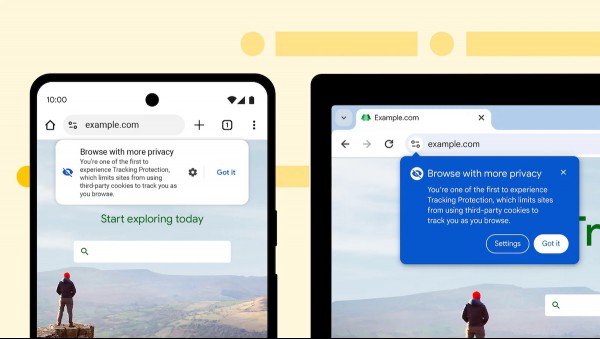
The Tracking Protection feature will be enabled by default for the selected users, and it will automatically block all tracking requests from third-parties that may try to access the data. Users will be able to toggle the feature off, i.e. enable tracking cookies on, at any time, by clicking on the eye icon in the address bar. While that may not sound like a good idea, Google mentions that blocking third-party cookies could break some websites. Now, not all third-party tracking cookies are bad per se. Some are used to sign in to other websites, for example, many sites support sign in with Google, Microsoft, Steam account, etc. These may be useful as they provide easier ways to log in to the services.
1% of the user base is not a lot of people, but it makes sense that Google wants to trial the feature among a small group of users, given that this is just part of the test phase. The search giant wants to gather feedback from its testers, before rolling out the change widely, which could happen in the 2nd half of 2024.
If you can't wait for that, just install a good ad blocker like uBlock Origin or AdGuard, to prevent trackers and ads across websites. Other browsers already have the feature baked in, take a look at Firefox's Enhanced Protection, or Brave Browser's setting to disable cross-site tracking.
RECOMMENDED NEWS

Linux Mint 21.3 is now available with experimental Wayland support
Linux Mint 21.3 is the third and final point update for the Linux Mint distribution. The developers...

Bitwarden Authenticator now lets you import TOTP tokens from other authenticator apps
Bitwarden Authenticator has added support for exporting and importing Time-based One-Time Passwords...

With Kaspersky banned in the US, what should customers do?
The United States are banning Kaspersky products. Starting July 20, Kaspersky is no longer allowed ...

Netflix prices are increasing again
Netflix is once again increasing the monthly prices of its subscription plans across multiple count...

WinScript: open-source tool to configure and debloat Windows
Plenty of tools exist that give users more control over the Windows operating system. Applications ...

ChatGPT Deep Research is now available for free users, with some limitations
OpenAI has announced that its research tool, Deep Research, is now available for free ChatGPT users...
Comments on "Google Chrome will disable third-party tracking cookies for some users in January 2024" :